
Ask the Expert: Are Historic Newport Doors Original?
The most common question I’m asked about doors on historic houses is, “Do you think it’s original?” It’s a great question—and one that reflects Newporters’ interest in the history of our town. If only doors could talk, what stories they would tell! Would they lie about their age? Share tales about past lives as trees? Complain about all the handshaking?
Estimating whether a door is original depends on how you define the term. It may date to the original construction, to a later renovation, or be a newer door made in an original style. Let’s take a look at a few door stories from around town.
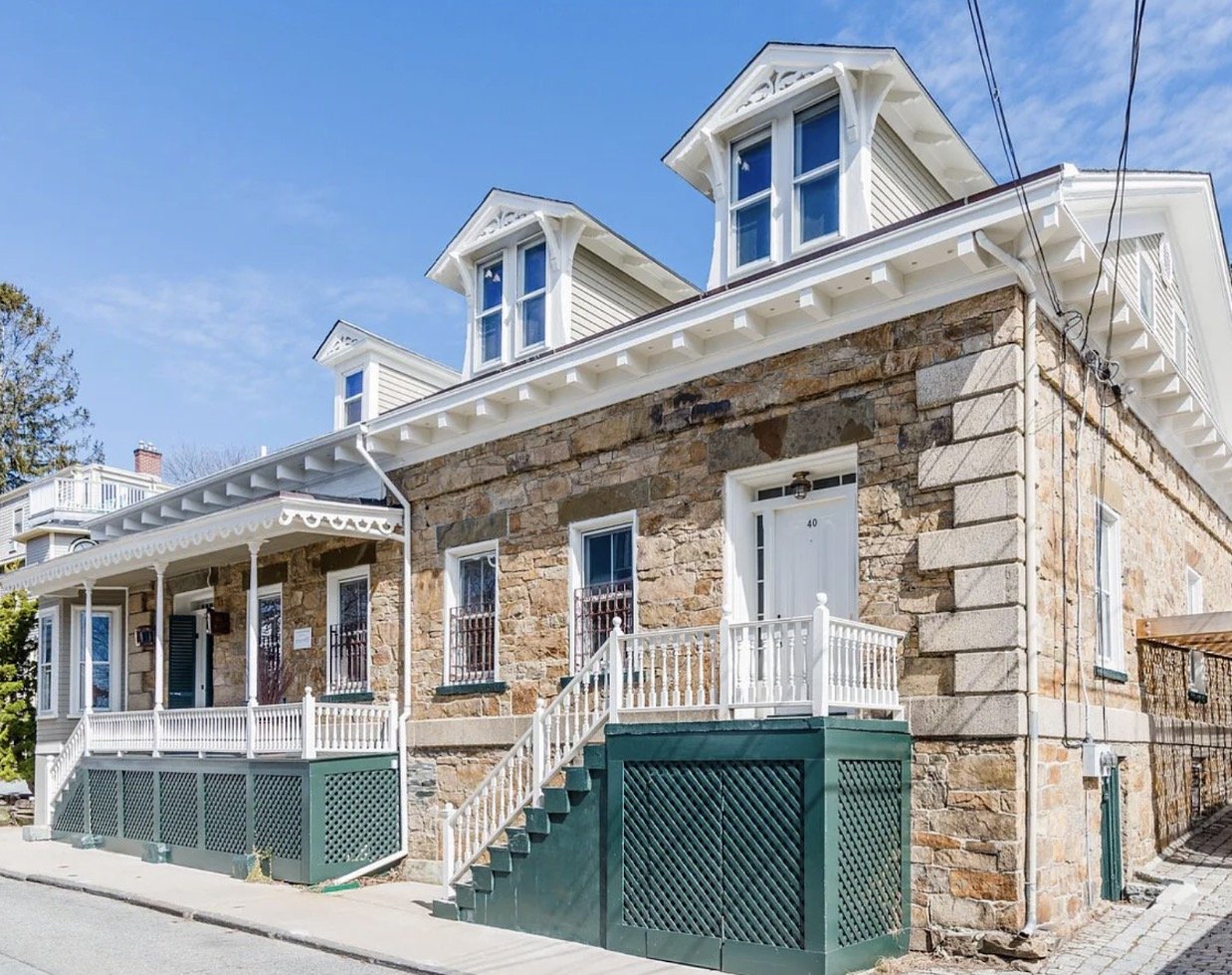
My first job as a carpenter was repairing the front door of the Winthrop–Eckley Double House (c. 1855). My wife Allyson and I were newly married and renting an apartment on the first floor. At the end of a rather spare month, our landlord graciously offered me the task of replacing the rotting threshold. While I didn’t have much experience, I did have a hammer and youthful enthusiasm.
When I finally managed to remove the old wood, I found a wheat penny from 1919. I’d heard of sailors placing a coin under the mast to bring good luck, so I imagined the carpenter before me had followed a similar custom. The house was built sixty years before the penny’s date, suggesting a repair to the original door. Before fitting my oak threshold, I placed a 2008 penny beside his.
A bit further down that same street is the Corne House (c. 1822), built for the artist Michele Corne, who is credited with introducing the tomato to the American diet. At the time, most New Englanders believed tomatoes to be poisonous. My grandparents, Bob and Phylis Brown, once owned the house, and I remember the thin interior doors, made from planks and fitted with colonial thumb latches. Interior doors tend to last longer than exterior ones, and these may well have been original. The front door is still painted the same color today—a tomato-sauce red.
A few blocks away is St. Mary’s Church (c. 1852) at the corner of Spring Street and Memorial Boulevard. The Gothic Revival building has Tudor-style doors with a four-centered archtop. The varnished wood doors are hung on ornate strap hinges. Jackie and John Kennedy were famously married here, passing through the same doorway to be greeted by thousands of well-wishers gathered outside.
On the way out of town is Island Cemetery on Farewell Street. Nestled at its center is the Belmont Chapel (c. 1888). Once overgrown with ivy and in serious disrepair, the chapel was fully restored in 2025 by the Belmont Chapel Foundation, supported by major grants from the Alletta Morris McBean Charitable Trust, the van Beuren Charitable Foundation, Preserve RI/1772, and the Champlin Foundation, along with contributions from individual donors. A local builder, The Damon Company, carried out the restoration with a team of skilled tradespeople. Our company was asked to hang the massive archtop doors. The iron hardware was refurbished by a local blacksmith.
So—are all of these doors original? In some cases, yes. In others, they reflect a long history of care and renewal. Newport’s exterior doors face constant weather and daily use, and even the best-built examples eventually need attention. Sometimes that means repair; other times it means a replacement that honors the original design. What matters most is the shared commitment to preserving the character of these buildings. In Newport; that commitment is part of the story, whether a door is truly original or thoughtfully renewed.
Cody Harple
Owner, Classic Door LLC
